Friday, April 14, 2017

NaPoWriMo 2017 - Prompt #14 - Nature Haiku

Japanese pond in a garden - with lily pads and frog.
Building on our theme from yesterday (nature poetry) we are going to focus today on the form of the haiku.  At Poets.org we read this succinct description:

"Haiku began in thirteenth-century Japan as the opening phrase of a renga, a form of spoken poem, generally 100 stanzas long, which was also composed syllabically. The much shorter haiku broke away from renga in the sixteenth-century, and was mastered a century later by the poet Matsuo Basho, who wrote this classic example:"
An old pond!
A frog jumps in—
the sound of water.
Basho executed the form with subtle perfection, including moments of reflection, joy, and even humor:

            now then, let's go out
            to enjoy the snow... until
            I slip and fall!

The traditional form is generally viewed as three lines with five, seven, and then five syllables each.  Although breaking the form is common in modern poetry.  There are many other aspects to a haiku, not just the length and form.  For example, a "haiku traditionally contains a kigo, a word or phrase that symbolizes or implies the season of the poem."  The specific words in Japanese were proscribed, and each pointed to a specific season.  Frogs, cherry blossoms, and swallows signify spring.  Summer is indicated by words such as the lotus flower, cicada, and the rainy season.  Autumn is denoted with the full Moon, crickets, and colored leaves.  Finally, the cold, fallen leaves, snow, and winter holidays all indicate the winter season.

Prompt #14:  Write a nature haiku based on a natural scene either before you, in your memory, or in a picture.  Include as many aspects of a traditional haiku as you can - the syllable count, a word or phrase for the season, and a 'surprise' moment for the end.  As you ponder your scene, consider what will evoke it in the shortest number of words.  What is the 'ah-ha' moment that comes to you, the twist or surprise that will make a reader nod or gasp, reading your poem?   

For something more specific, write four haiku about your scene.  Each should reflect the view in a different season.

As usual, I'm pondering nature haiku from a sci-fi, horror, or fantasy point of view.  I think this one will end up as another werewolf poem, but what can you do?

Did you use this or one of our other prompts?  You can post your poem in our comments, if you like.

Happy Writing!

Prompts crafted by:
J.A. Grier, Senior Scientist and Education Specialist, Planetary Science Institute
Amy Grier, Managing Editor, Solstice Literary Magazine
Image Credits: Japanese Garden  CC 3.0 Wikimedia Commons

Thursday, April 13, 2017

NaPoWriMo 2017 - Prompt #13 - Inspired by Nature

Akaka Falls State Park in Hawaii.
Our parks have a long, complicated
history between humans and nature.
A common source of inspiration for poetry is the natural world.  Poets have often been inspired by landscapes, the flora and fauna, and how these change with the seasons and over time.  There is a long history of poetry and poetic forms dedicated to nature.  Often, the poet uses some aspect of the natural world as a metaphor to illustrate or support some other idea or conflict.  Nature poetry can express the relationship with humankind in a variety of ways; pleasure over agricultural cultivation, guilt over mining, fear over storms and earthquakes, and more.

Prompt #13:  Write a poem inspired by nature.  You can use memory of a place you have been, or a photo of a place you would like to visit, to inspire you.  Find unique ways into the scene or the natural experience using all of your senses, what you see, hear, feel, smell, and even taste.  Consider the relationship between humanity and nature that you encounter in the scene.  Craft your poem using as many concrete images as you can.

For something more specific, consider how your natural scene changes or will change with time and the seasons, and include those changes in the poem. 

Today I might focus on the science end of sci-fi by using the universe as my natural scene.  But if that fails, as always there is a fantasy or horror element in there somewhere to explore :)

Did you use this or one of our other prompts?  You can post your poem in our comments, if you like.

Happy Writing!

Prompts crafted by:
J.A. Grier, Senior Scientist and Education Specialist, Planetary Science Institute
Amy Grier, Managing Editor, Solstice Literary Magazine
Image Credits: My pic of Akaka Falls.

Wednesday, April 12, 2017

NaPoWriMo 2017 - Prompt #12 - Refocus the Pronoun

Our usual starting focus.
We approach poetry from the base of our own experience.  It is therefore no surprise that many poems are written from the perspective of the first person - the "I."  But sometimes we gravitate to this kind of focus when another would better suit.  Especially for emotional poetry, the first person perspective can be overwhelming and sometimes even overwrought.  Exploring points of view can generate new ideas and new options we had not considered.  Exploring both second and third person pronouns can breathe new life into your creation.

Prompt #12Idea One - Take a poem you have previously written from the point of view of "I" and refocus it - either change the pronouns to something like "you," "they," "E," "Xe," or remove the need for pronouns completely.  What does this refocusing do to the poem?  Does it reinforce the main ideas, emphasize the imagery, or distance the reader?  Idea Two - If you don't have a poem to start with, then use this prompt as a chance to craft something new that's not from the "I" point of view.  Explore how the same poem changes if you craft it from different points of view.

Not sure which old poem I will choose, but of course it will be something in the sci-fi, horror, or fantasy genres.

Did you use this or one of our other prompts?  You can post your poem in our comments, if you like.

Happy Writing!

Prompts crafted by:
J.A. Grier, Senior Scientist and Education Specialist, Planetary Science Institute
Amy Grier, Managing Editor, Solstice Literary Magazine
Image Credits: "I" GNU Free Documentation License, Wikimedia Commons

Tuesday, April 11, 2017

Four Poems in The Were-Traveler

My poem 'Finish the Job' is a macabre
look at a mummy in the making.
Time is doing that thing it does where it flies by so fast I can't keep up.  I've realized that I had some poems published in December and never blogged about them here!  Since this is indeed already April, and National Poetry Month, I think it is appropriate to call your attention to the issue (which I think is a good read.)  It is Issue #19 - Speculative Poetry, over at The Were-Traveler.  I have four poems in this issue that is jam-packed with 71 poems of the sci-fi, fantasy, horror, science, or just plain strange variety.

The four poems I have appearing in the issue are:  Finish the Job, Token of Affection, Flight School, and The Perfect Poem … Tribute.  For three of these poems the editor selected a piece of art or other image to highlight the poem.  So if you haven't had your fix of speculative poetry today, pop on by and give them a read!

Image Credit:  Mummy, Wikimedia Commons, GNU Free Use 1.2

NaPoWriMo 2017 - Prompt #11 - Breaking the Rules

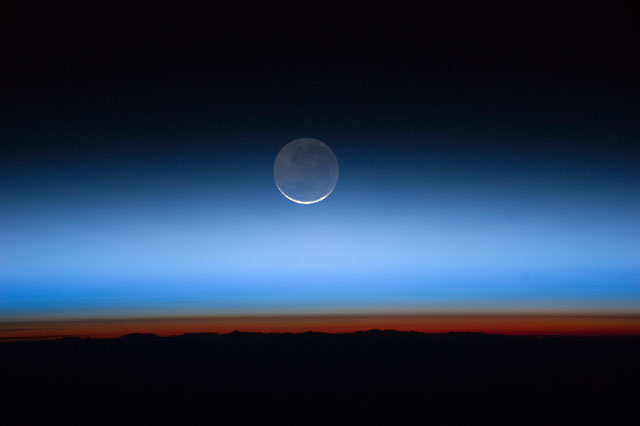
The Moon as seen from the International Space Station,
hanging over the limb of the Earth.  Not your standard
view of the Moon - this image evokes something new.
A common bit of advice in writing is "Learn the Rules, Break the Rules."  Something very fresh can happen when we seem to be following along a known path, and then go somewhere unexpected.  So what are some of the "rules" of poetry, if there is such a thing?  Here are a few you may have heard:
  • Don't write cliches.  Cliched poems include poetry about the Moon, your dog, and your breakup.
  • Don't use epigraphs.  These are those bits of quotes or song lyrics at the top of your writing showing your inspiration source. 
  • Don't use a word in all capitals.  This is SHOUTING in your poem.
  • Don't write "doggerel" forms like Limericks or "Greeting Card" verse.
  • Don't break classic forms.  For example, don't change the standard rhyme scheme of a sonnet.
  • Always be honest.  The standard wisdom is that the truth resonates with the reader.
Prompt #11:  Write a poem that breaks a "rule" of poetry writing.  Use an epigraph, write a Limerick, or tell a lie.  Why did you choose to break this particular "rule?"  It what way does breaking this rule give you as the writer some additional freedom?  It what ways does breaking the rule impose new limits?  As you craft your poem, look for ways to use this broken rule to bring something unexpected and new into the work.

There is no "For something more specific ..." today!  Just go and break rules.

Of course I'll be breaking the rules with some aspect of sci-fi, horror, or fantasy.  Maybe it is time for yet another poem about the Moon ...

Did you use this or one of our other prompts?  You can post your poem in our comments, if you like.

Happy Writing!

Prompts crafted by:
J.A. Grier, Senior Scientist and Education Specialist, Planetary Science Institute
Amy Grier, Managing Editor, Solstice Literary Magazine
Image Credits: Moon, NASA

Monday, April 10, 2017

NaPoWriMo 2017 - Prompt #10 - The Mundane

The mundane spoon.
Where can this concept lead?
Consider the spoon.  It is a simple, everyday object.  It does not seem to have much about it that one might consider poetic.  But there are many different ways to consider the humble spoon ... how about 'spooning' as sleeping next to someone, a souvenir spoon collection,  a spoon used as a percussion instrument, or 'spoon feeding' someone information?  And of course there are strange crossovers like the 'spork.'

There is a paradox in poetry - the more specific and concrete the language and imagery, the more universal and accessible the poem becomes.  A poem that is more general and less specific is less relatable.  Therefore, writing about the mundane creates pathways for the reader to enter and engage with the poem.   

Here are a few other thoughts about the spoon ...

"I was born with a plastic spoon." - Pete Townshend
"Gag me with a spoon." - Valley talk, attributed to Moon Unit Zappa among many others ...
"Ten thousand spoons when all you need is a knife." - Not an example of irony, by Alanis Morisette
"Spoon!" - Battle cry of comic hero The Tick.

Prompt #10:  Write a poem about a spoon (or other specific, concrete, mundane object).  Consider some of the ideas above about the spoon, and others like taking medicine, measuring ingredients, or stirring tea.  Consider what it is made out of, what it holds (or once held) and if it still matches the set.  Craft your poem to be as specific as possible about your mundane object.

To make the prompt more detailed, you can write a sonnet about your mundane object, and put a little surprise about it in your final couplet.

Of course I'll be wondering what mundane aspect of sci-fi, horror, or fantasy I need to consider.

Did you use this or one of our other prompts?  You can post your poem in our comments, if you like.

Happy Writing!

Prompts crafted by:
J.A. Grier, Senior Scientist and Education Specialist, Planetary Science Institute
Amy Grier, Managing Editor, Solstice Literary Magazine
Image Credits: Dessert Spoon CC 3.0 Wikimedia Commons

Sunday, April 9, 2017

NaPoWriMo 2017 - Prompt #9 - Jargon

A slice of the gorgeous meteorite Esquel, with its clasts of
gem-like peridot (olivine).  Meteorites are often studied by
Cosmochemists to learn more about the early Solar System.
Continuing along the idea of language, our next prompt deals with "jargon."  Jargon is a unique vocabulary that is commonly associated with a job or discipline.  For example, let's look at some of the words found in the discipline of Cosmochemistry.  There we find words and phrases such as:  ternary diagram, cosmic abundances, chondritic, CRE age, presolar grains, and mass spectrometry.  These words all have a very specific meaning to me, and help me understand more precisely what another scientist is trying to say.  However, if I were not familiar with Cosmochemistry, many of these terms would mean nothing, or worse, create misconceptions.  Jargon can include slang or an in-group language.  It can separate those who are included from those who are not.  Or it can include more people by attempting to specifically clarify meanings.

Prompt #9:  Write a poem that uses at least one word of jargon from a single discipline or source.  Are you using this word to be more specific, that is, to better communicate an idea?  Or are you using it to create a lack of understanding and distance?  Is your use of jargon one that creates an air of authority or expertise around your poem?  Is the language used to protect and shield, or to open and reveal?  Consider these questions when crafting your poem.

For something more specific, and a little bit of fun, use a rhyme scheme in your poem where one or more jargon words are rhymed.  Need some additional fun?  When crafting your poem, use a discipline with which you are completely unfamiliar, so that is requires some research to write.

The fields of science fiction, horror, and fantasy have their own jargon.  So perhaps I'll look there for a bit of inspiration, myself.

Did you use this or one of our other prompts?  You can post your poem in our comments, if you like.

Happy Writing!

Prompts crafted by:
J.A. Grier, Senior Scientist and Education Specialist, Planetary Science Institute
Amy Grier, Managing Editor, Solstice Literary Magazine
Image Credits:  Esquel  CC 2.0 Wikimedia Commons

Saturday, April 8, 2017

NaPoWriMo 2017 - Prompt #8 - Absence

In a field / I am the absence / of field.
In the poem "Keeping Things Whole" by Mark Strand, we encounter a unique treatment of the concept of absence.  A recognition that, just by being, we must create a space for ourselves within the larger environment.  We push ourselves into the air, the flowers, the wheat.  Where we are, those things are not.  Then we pass through, and the field remains nothing but a field once again.  Absence is so much more than a empty place.  In some Asian architecture and decorating, the lack of a item or piece of furniture is just as important as a piece placed elsewhere. (i.e. Feng Shui)  The nothingness has both form and function.

Prompt #8:  Write a poem that evokes absence.  Consider the concept in its broadest sense.  Write the poem that grapples with nothingness - its definition, its function, and the emotions around it.  Consider loss - the space once claimed by a person, animal, or place that used to be in your life.  Perhaps it is the loss of a function, a role, a job, or friends.  Write the poem that explores something that is not there.

For something more specific, try playing with the white space on the page.  Play with line lengths, word spacing, and paragraph breaks.

And of course I'll be considering the concept of absence as reflected in science fiction, horror, and fantasy.

Did you use this or one of our other prompts?  You can post your poem in our comments, if you like.

Happy Writing!

Prompts crafted by:
J.A. Grier, Senior Scientist and Education Specialist, Planetary Science Institute
Amy Grier, Managing Editor, Solstice Literary Magazine
Image Credits: A Field in Belgium


By I, Luc Viatour, CC BY-SA 3.0, https://commons.wikimedia.org/w/index.php?curid=998412

Friday, April 7, 2017

NaPoWriMo 2017 - Prompt #7 - Counting Up and Down

Counting - a way to win, and a way to know you've won.
The whole concept of numbers and the process of counting is fascinating.  Carl Sagan says, "The simplest thought, like the concept of the number one, has an elaborate logical underpinning."  Imagine then the processing behind the otherwise straightforward act of counting from one to ten.  Go from there to think about just how many things we count - time, music, money, collections, and so much more, and we realize counting is part of the complex language of culture - the how and why we count.

Prompt #7:  Write a poem that evokes the concept of counting.  Imagine some of these examples to get you started:  counting to ten when angry, counting the minutes going by as we wait impatiently, counting in a number system other than base ten, such as binary, counting and skipping a number, countdowns, awarding prizes in order of first, second, third, counting cards, and all the words we use for things that are counted.

For something more specific, try writing your poem in a verse structure, like a sonnet, that requires the counting of lines and rhymes.

And of course I'll be considering different aspects of counting as reflected in science fiction, horror, and fantasy!

Did you use this or one of our other prompts?  You can post your poem in our comments, if you like.

Happy Writing!

Prompts crafted by:
J.A. Grier, Senior Scientist and Education Specialist, Planetary Science Institute
Amy Grier, Managing Editor, Solstice Literary Magazine
Image Credits: RoyalFlushHearts, public domain.  Wikimedia Commons