Monday, April 17, 2017

NaPoWriMo 2017 - Prompt #17 - Choices


Actual paths diverging in an actual wood.
With an actual copy of Frost's poem posted there.
In the book Harry Potter and the Chamber of Secrets, the wizard Dumbledore says succinctly, "It is our choices, Harry, that show what we truly are ..."  The importance of choice in shaping character, destiny, relationships and more has long been explored in literature.  A famous example in poetry is The Road Not Taken by Robert Frost:

     I shall be telling this with a sigh
     Somewhere ages and ages hence:
     Two roads diverged in a wood, and I—
     I took the one less traveled by,
     And that has made all the difference.

A search for choices in poetry reveals many gems ... here are a couple of stanzas.

Choices by Tess Gallagher

     saw in hand, I see a nest clutched in
     the uppermost branches.
     I don’t cut that one.
     I don’t cut the others either.

Choice by Emily Dickinson

     When figures show their royal front
     And mists are carved away, --
     Behold the atom I preferred
     To all the lists of clay!

Prompt #17:  Write a poem that includes an important choice.  Is this a choice that defines a future fate?  Does this choice influence relationships with people, animals, or the Earth?  Or perhaps it is a choice that elucidates or reinforces some aspect of character?  Consider these questions as you craft your poem. 

For something more specific, make your poem very short.  Choose each word with great care, thinking not just about the words you are choosing, but the ones that are not being chosen, as well.

As as always I'll be using the prompt somehow in a sci-fi, horror, or fantasy context.

Did you use this or one of our other prompts?  You can post your poem in our comments, if you like.

Happy Writing!

Prompts crafted by:
J.A. Grier, Senior Scientist and Education Specialist, Planetary Science Institute
Amy Grier, Managing Editor, Solstice Literary Magazine
Image Credits:  Woodland paths Wikimedia Commons CC2.0 Tony Atkin

Sunday, April 16, 2017

NaPoWriMo 2017 - Prompt #16 - Supernatural

The Raven - Good or bad omen?
We've done several prompts dealing with nature and natural elements, so it is time to flip that and consider the supernatural, instead.  These are poems that contain elements that are beyond the natural world as most people perceive it.  They might include magic or ghosts, professions like medium or sorcerer, or abilities like telekinesis or telepathy.

Themes such as these are common in classic poetry, such as represented in this last stanza from "The Raven" By Poe:

And the Raven, never flitting, still is sitting, still is sitting
On the pallid bust of Pallas just above my chamber door;
    And his eyes have all the seeming of a demon’s that is dreaming,
    And the lamp-light o’er him streaming throws his shadow on the floor;
And my soul from out that shadow that lies floating on the floor
            Shall be lifted—nevermore!

Supernatural poetry hardly has to be grim.  There are poems of good fairies, kindly ghosts, and benevolent powers.  Some prophesies and omens lead to the fabled chest of gold.

Prompt #16:  Write a supernatural poem.  What elements will you include that are beyond the usual conception of the natural world?  Will your poem be uplifting, dark, or will it strike a balance?  How does the use of a supernatural element in the poem free your creativity, and on the other hand, how does it limit you?  In what ways does using supernatural elements change how you approach writing a poem?  Consider these questions as you craft your poem. 

For something more specific, shape the bones of your poem to reinforce the theme.  Do something unexpected with the line lengths or spacing. 

Supernatural is of course a perfect prompt for sci-fi, fantasy and horror - lots of options.

Did you use this or one of our other prompts?  You can post your poem in our comments, if you like.

Happy Writing!

Prompts crafted by:
J.A. Grier, Senior Scientist and Education Specialist, Planetary Science Institute
Amy Grier, Managing Editor, Solstice Literary Magazine
Image Credits: female raven, GNU Free Documentation, CC 3.0, Wikimedia Commons

Saturday, April 15, 2017

NaPoWriMo 2017 - Prompt #15 - To Make Human


The Easter Bunny is an
anthropomorphized rabbit.
The assignation of human traits or humanity to an inanimate or inhuman object is a common device in poetry. For example, Silvia Plath gave human life to flowers in her poem "Poppies in October." The final lines are:

Oh my God, what am I
That these late mouths should cry open
In a forest of frosts, in a dawn of cornflowers

The poppies now possess mouths that can cry like human mouths. It emphasizes the speaker's feelings, their astonishment at being in just this place, at just this time, to witness this spectacle.

So what's the difference between "personification" and "anthropomorphism?"  Everyone seems to have their own answer for this, as the two terms are so closely related.  The Merriam Webster Dictionary says this about personify: "to conceive of or represent as a person or as having human qualities or power" or "to be the embodiment or personification of : i.e. a teacher who personified patience."  Anthropomorphism is defined as "to attribute human form or personality to things not human."  A lot of Disney sidekicks are animals that have been completely anthropomorphized such as Jiminy Cricket from Pinocchio or Sebastian the crab from The Little Mermaid.

Prompt #15:  Write a poem in which an object, deity, animal, or other inhuman object is given human traits, or acts as a human being.  How has it become the embodiment of human characteristics?  What is this object thinking, doing, and feeling?  How does this personification or anthropomorphism work in your poem?  Consider these questions as you craft your poem. 

For something more specific, try following a rhyme scheme in your poem.

There are so many options for "to make human" in fantasy, horror, or sci-fi i hardly know where to start ...

Did you use this or one of our other prompts?  You can post your poem in our comments, if you like.

Happy Writing!

Prompts crafted by:
J.A. Grier, Senior Scientist and Education Specialist, Planetary Science Institute
Amy Grier, Managing Editor, Solstice Literary Magazine
Image Credits: Easter Bunny Postcard 1907 Wikimedia Commons.  Public Domain

Friday, April 14, 2017

Top Ten Reasons You Don't Have an Agent Yet - AWP Panel

Want to seal the deal with an agent?
Check this top ten and see
if you are ready to go.
This is a continuation of my previous post "Demystifying the Business Side of Writing and Publishing" which was a panel at the 2017 AWP conference.  One of the topics the panel spent the most time on was 'getting an agent.'  The panel had so many ideas related to this that I figured it deserved its own post.

To reiterate, the panel members as listed in the guide are: Whitney Davis, Tarfia Faizullah, Paula Munier, Joshua Shenk, and Andrew McFadyen-Ketchum.  Again, I was completely blocked in a packed room and could not see the panel table, so I wasn't sure who was speaking when.  But I think the bulk of this was shared by Paula Munier, who was introduced as an agent.

Top Ten Reasons You Don't Have an Agent Yet:
  1. You are approaching the wrong agent.  You need to have a similar sensibility to the agent you have selected.  These people are swamped with submissions they will never represent because the authors have not done their homework.  Send only to people you think will really resonate with your work.
  2. You are not being strategic.  This is related to the above.  Don't just send work out to anyone at all, have a solid plan and reasons for that plan.
  3. Your query letter isn't working.  The query letter needs to be "sales copy" and many writers are not good at that kind of writing.  A query is a pitch, and needs to be written like one.
  4. Your story idea isn't unique.  The story has to stand out against the competition or against those that are in the same market.  Focus on what makes you and your work unique or special and enhance those traits.
  5. You don't know the competition.  Related to the above.  Read more within your own market and community to know how to make your work stand out.  Support your own community by reading.
  6. Your story idea isn't strong.  Even a unique idea must be strong enough to sustain a book length narrative.
  7. Your story idea is not well executed.  It's unique and goes the distance, but there are other issues ... can you cleanly pitch this story in 50 words or less to sell it?  If not, there may be issues with execution of the story.
  8. Your craft is not high enough yet.  Again, related to the above.  Stories have to be crafted at the highest level to have a chance, since competition is so keen.  Look to your community to find ways to bolster your craft and make your story flawless.
  9. You are not active.  You need to be an active member of your writing community, at the local, national, and perhaps even international levels.  An agent wants to see you as a contributing part of this body of people.
  10. You are not prepared to be an author.  This is different from being a writer - being an author requires signings, social media, personal appearances, and more.  If the agent does not feel you are ready to be that person, they will not sign you.  Get good recommendations from established authors in your market.  Publish your work in other formats.  Have a solid writer's platform.  Present all work and yourself professionally.
Image Credit:  Handshake  Wikimedia Commons, CC 2.0
https://commons.wikimedia.org/wiki/File:Hermandad_-_friendship.jpg

NaPoWriMo 2017 - Prompt #14 - Nature Haiku

Japanese pond in a garden - with lily pads and frog.
Building on our theme from yesterday (nature poetry) we are going to focus today on the form of the haiku.  At Poets.org we read this succinct description:

"Haiku began in thirteenth-century Japan as the opening phrase of a renga, a form of spoken poem, generally 100 stanzas long, which was also composed syllabically. The much shorter haiku broke away from renga in the sixteenth-century, and was mastered a century later by the poet Matsuo Basho, who wrote this classic example:"
An old pond!
A frog jumps in—
the sound of water.
Basho executed the form with subtle perfection, including moments of reflection, joy, and even humor:

            now then, let's go out
            to enjoy the snow... until
            I slip and fall!

The traditional form is generally viewed as three lines with five, seven, and then five syllables each.  Although breaking the form is common in modern poetry.  There are many other aspects to a haiku, not just the length and form.  For example, a "haiku traditionally contains a kigo, a word or phrase that symbolizes or implies the season of the poem."  The specific words in Japanese were proscribed, and each pointed to a specific season.  Frogs, cherry blossoms, and swallows signify spring.  Summer is indicated by words such as the lotus flower, cicada, and the rainy season.  Autumn is denoted with the full Moon, crickets, and colored leaves.  Finally, the cold, fallen leaves, snow, and winter holidays all indicate the winter season.

Prompt #14:  Write a nature haiku based on a natural scene either before you, in your memory, or in a picture.  Include as many aspects of a traditional haiku as you can - the syllable count, a word or phrase for the season, and a 'surprise' moment for the end.  As you ponder your scene, consider what will evoke it in the shortest number of words.  What is the 'ah-ha' moment that comes to you, the twist or surprise that will make a reader nod or gasp, reading your poem?   

For something more specific, write four haiku about your scene.  Each should reflect the view in a different season.

As usual, I'm pondering nature haiku from a sci-fi, horror, or fantasy point of view.  I think this one will end up as another werewolf poem, but what can you do?

Did you use this or one of our other prompts?  You can post your poem in our comments, if you like.

Happy Writing!

Prompts crafted by:
J.A. Grier, Senior Scientist and Education Specialist, Planetary Science Institute
Amy Grier, Managing Editor, Solstice Literary Magazine
Image Credits: Japanese Garden  CC 3.0 Wikimedia Commons

Thursday, April 13, 2017

NaPoWriMo 2017 - Prompt #13 - Inspired by Nature

Akaka Falls State Park in Hawaii.
Our parks have a long, complicated
history between humans and nature.
A common source of inspiration for poetry is the natural world.  Poets have often been inspired by landscapes, the flora and fauna, and how these change with the seasons and over time.  There is a long history of poetry and poetic forms dedicated to nature.  Often, the poet uses some aspect of the natural world as a metaphor to illustrate or support some other idea or conflict.  Nature poetry can express the relationship with humankind in a variety of ways; pleasure over agricultural cultivation, guilt over mining, fear over storms and earthquakes, and more.

Prompt #13:  Write a poem inspired by nature.  You can use memory of a place you have been, or a photo of a place you would like to visit, to inspire you.  Find unique ways into the scene or the natural experience using all of your senses, what you see, hear, feel, smell, and even taste.  Consider the relationship between humanity and nature that you encounter in the scene.  Craft your poem using as many concrete images as you can.

For something more specific, consider how your natural scene changes or will change with time and the seasons, and include those changes in the poem. 

Today I might focus on the science end of sci-fi by using the universe as my natural scene.  But if that fails, as always there is a fantasy or horror element in there somewhere to explore :)

Did you use this or one of our other prompts?  You can post your poem in our comments, if you like.

Happy Writing!

Prompts crafted by:
J.A. Grier, Senior Scientist and Education Specialist, Planetary Science Institute
Amy Grier, Managing Editor, Solstice Literary Magazine
Image Credits: My pic of Akaka Falls.

Wednesday, April 12, 2017

NaPoWriMo 2017 - Prompt #12 - Refocus the Pronoun

Our usual starting focus.
We approach poetry from the base of our own experience.  It is therefore no surprise that many poems are written from the perspective of the first person - the "I."  But sometimes we gravitate to this kind of focus when another would better suit.  Especially for emotional poetry, the first person perspective can be overwhelming and sometimes even overwrought.  Exploring points of view can generate new ideas and new options we had not considered.  Exploring both second and third person pronouns can breathe new life into your creation.

Prompt #12:  Idea One - Take a poem you have previously written from the point of view of "I" and refocus it - either change the pronouns to something like "you," "they," "E," "Xe," or remove the need for pronouns completely.  What does this refocusing do to the poem?  Does it reinforce the main ideas, emphasize the imagery, or distance the reader?  Idea Two - If you don't have a poem to start with, then use this prompt as a chance to craft something new that's not from the "I" point of view.  Explore how the same poem changes if you craft it from different points of view.

Not sure which old poem I will choose, but of course it will be something in the sci-fi, horror, or fantasy genres.

Did you use this or one of our other prompts?  You can post your poem in our comments, if you like.

Happy Writing!

Prompts crafted by:
J.A. Grier, Senior Scientist and Education Specialist, Planetary Science Institute
Amy Grier, Managing Editor, Solstice Literary Magazine
Image Credits: "I" GNU Free Documentation License, Wikimedia Commons

Tuesday, April 11, 2017

Four Poems in The Were-Traveler

My poem 'Finish the Job' is a macabre
look at a mummy in the making.
Time is doing that thing it does where it flies by so fast I can't keep up.  I've realized that I had some poems published in December and never blogged about them here!  Since this is indeed already April, and National Poetry Month, I think it is appropriate to call your attention to the issue (which I think is a good read.)  It is Issue #19 - Speculative Poetry, over at The Were-Traveler.  I have four poems in this issue that is jam-packed with 71 poems of the sci-fi, fantasy, horror, science, or just plain strange variety.

The four poems I have appearing in the issue are:  Finish the Job, Token of Affection, Flight School, and The Perfect Poem … Tribute.  For three of these poems the editor selected a piece of art or other image to highlight the poem.  So if you haven't had your fix of speculative poetry today, pop on by and give them a read!

Image Credit:  Mummy, Wikimedia Commons, GNU Free Use 1.2

NaPoWriMo 2017 - Prompt #11 - Breaking the Rules

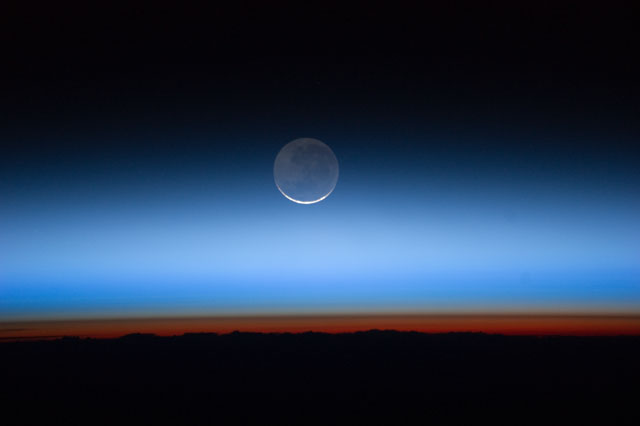
The Moon as seen from the International Space Station,
hanging over the limb of the Earth.  Not your standard
view of the Moon - this image evokes something new.
A common bit of advice in writing is "Learn the Rules, Break the Rules."  Something very fresh can happen when we seem to be following along a known path, and then go somewhere unexpected.  So what are some of the "rules" of poetry, if there is such a thing?  Here are a few you may have heard:
  • Don't write cliches.  Cliched poems include poetry about the Moon, your dog, and your breakup.
  • Don't use epigraphs.  These are those bits of quotes or song lyrics at the top of your writing showing your inspiration source. 
  • Don't use a word in all capitals.  This is SHOUTING in your poem.
  • Don't write "doggerel" forms like Limericks or "Greeting Card" verse.
  • Don't break classic forms.  For example, don't change the standard rhyme scheme of a sonnet.
  • Always be honest.  The standard wisdom is that the truth resonates with the reader.
Prompt #11:  Write a poem that breaks a "rule" of poetry writing.  Use an epigraph, write a Limerick, or tell a lie.  Why did you choose to break this particular "rule?"  It what way does breaking this rule give you as the writer some additional freedom?  It what ways does breaking the rule impose new limits?  As you craft your poem, look for ways to use this broken rule to bring something unexpected and new into the work.

There is no "For something more specific ..." today!  Just go and break rules.

Of course I'll be breaking the rules with some aspect of sci-fi, horror, or fantasy.  Maybe it is time for yet another poem about the Moon ...

Did you use this or one of our other prompts?  You can post your poem in our comments, if you like.

Happy Writing!

Prompts crafted by:
J.A. Grier, Senior Scientist and Education Specialist, Planetary Science Institute
Amy Grier, Managing Editor, Solstice Literary Magazine
Image Credits: Moon, NASA